New Doors · Linwood
Commercial Rolling Door Repair in Linwood
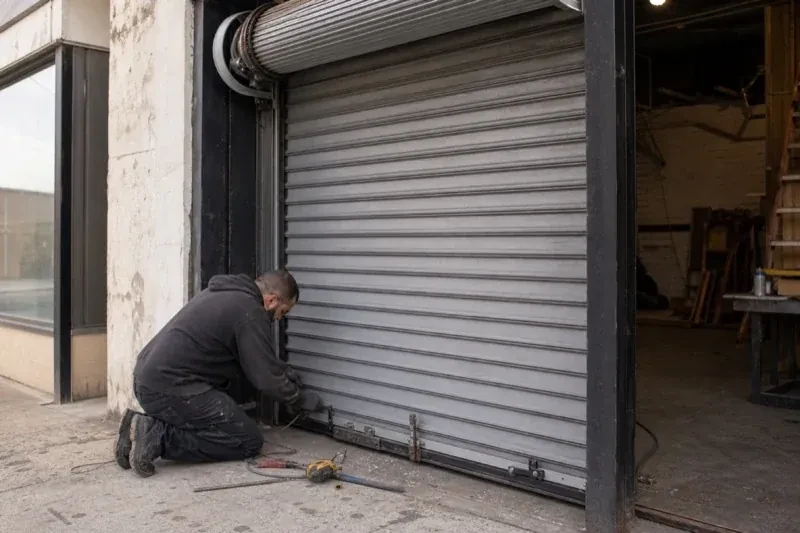
At closing time, the bottom bar reaches the floor on one end while daylight remains under the other. The slide bolts miss their keepers, leaving staff unable to secure the business opening in its usual way.
Commercial Rolling Door Repair
In plain words
Powered rolling doors add controls and protective devices to the mechanical assembly. A closing complaint may begin at the control station, interlock, sensing edge or photoelectric sensor rather than inside the operator. The visit checks the curtain's free movement first, then follows control response, brake action, limit settings, manual disconnect or hoist and external protection suited to that system. Compatible repairs are completed with the operating instructions in hand. Testing covers normal commands, stopping points, manual operation and protective-device response so staff understand how the restored door is intended to behave.
How the visit goesThe rolling door starts upward, then one side rises ahead of the other. Its bottom bar sits on an angle, several slats scrape the guide, and the opening is no longer clear enough for normal shipping traffic.
Linwood
How the visit goes
Read the curtain from bottom to coil
The curtain reveals how the door has been travelling. The bottom bar is checked for level, twist, impact marks and even contact with the sill. Moving upward, the inspection follows interlocking slats or sheet material, endlocks and windlocks for dents, separation, missing fasteners, polished rub marks or sideways shift. At the hood, the technician observes how the material enters the coil and whether it stacks evenly on the barrel. These clues show whether a damaged section can be renewed locally or whether distortion has spread far enough to affect guides, brackets and counterbalance.
Secure the curtain and stored energy
Repair starts by establishing a stable mechanical state. Power is isolated under the site's procedure, the operating controls are kept from use, and the work zone remains controlled. Depending on position and construction, the curtain is lowered, clamped, blocked or supported with suitable lifting equipment before a guide, bracket or drive part is loosened. Manual chains are secured and counterbalance components are treated as energised. This setup gives the technician control over weight and movement, allowing later adjustments to be deliberate. It also protects nearby stock and equipment while the opening is temporarily out of normal service.
A maintenance baseline for the facility
The completed service record becomes the starting point for routine door care. It can list the installed door and operator, repaired components, observed wear, test results and the manufacturer's inspection interval. Facility checks focus on visible conditions: new rub marks, loose fasteners, damaged slats, uneven bottom-bar position, frayed wiring, dirty sensor faces and changes in sound or operating effort. Spring tension and internal repairs remain technician work. Scheduling periodic inspection around the actual cycle count, exposure and manufacturer guidance makes future conversations specific and allows small changes to be compared with a known condition.
Commercial Rolling Door Repair
In the van
- Photoelectric sensors
- Barrel and headplate brackets
- Hand-chain hoist components
- Counterbalance spring assembly
- Sensing edge and controls
What affects the quote
Same fees day, night or weekend
1Traffic-control requirements
Loading schedules, pedestrian routes, lift-truck lanes and access to both faces determine how the work zone is maintained. Facility support and alternate routing form part of the service plan.
2Fire-protection label status
A labelled fire door needs assembly-specific component decisions, closing-path care and defined inspection or test records. Release-system and alarm-interface tasks remain visible as specialised line items.
3Manual drive components
Direct push-up operation, a hand-chain hoist or another manual drive has its own chain, wheel, reduction and keeper parts. Wear and accessibility determine the tasks included.
Commercial Rolling Door Repair: questions
Will operations have to stop around the doorway?
The opening and its adjacent traffic area need to remain controlled during inspection, repair and test cycles. Facilities often route people, lift trucks and deliveries through another path while that work is active. Planning around shipping periods, stored goods and access to both faces of the door helps define a workable service window and equipment setup.
Can access controls be tested with the door repair?
The door-side response to an authorised access signal can be included, along with key switches, interlocks and normal control stations. Account administration, private codes, network setup or security-system programming may belong to another provider. The handover records the functional interface tested while leaving sensitive credentials in the facility's control.
How should we prepare the loading area?
Move vehicles, pallets and loose packaging away from both faces of the opening, and identify an alternate route for staff and deliveries. Provide access to the control station, disconnect and any door records. A facility contact who understands normal operation and can authorise testing makes it easier to reproduce the complaint under controlled conditions.
Installation & Upgrades
- Insulated Steel Garage Door InstallationA refreshed exterior has made the faded garage door stand out.
- Wind-Rated Garage Door ReplacementA recent wind event left one section slightly creased, a strut twisted, and several track fasteners…
- Carriage-House Garage Door InstallationCold air is noticeable around the current door, especially near the floor and section joints.
Commercial Rolling Door Repair near you
If your door in Linwood is doing something new, there is a service here for it. Grinding usually points to rollers or hinges. A door that will not lift points to a spring or cable. A door that reverses on its own points to sensors or force settings. We diagnose first, then repair.