Openers · Waterloo
Chain-Drive Opener Repair
The door opens about a third of the way and stops. Turning the limit screw on the head has made no difference, and the trolley seems to sit in the wrong place along the rail when the door is fully closed.
Chain-Drive Opener Repair
In plain words
Sometimes nothing is broken and the operator has simply forgotten where the door should stop. Travel limits tell it how far to run in each direction; force settings tell it how much effort is normal, so it can notice an obstruction. When limits drift, a door stops short of the floor, reverses at the bottom or opens partway. When force is set low, the door reverses for no reason; set high, it stops protecting anyone beneath it. A chain-drive repair resets both, by screw on older heads or learn buttons on newer ones, then proves the reversal with a block on the floor.
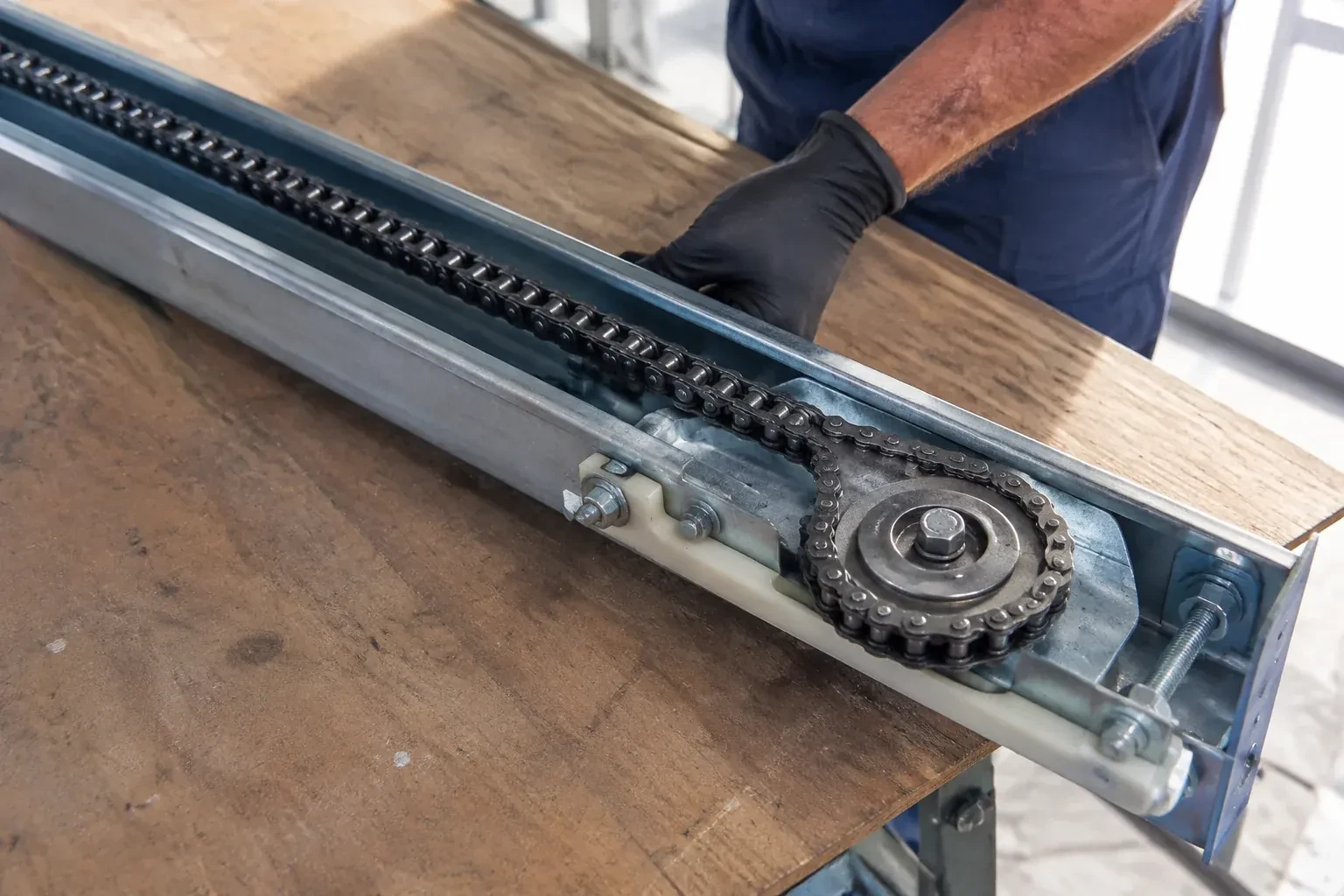
How the visit goesThe chain in the detached garage went orange with rust over the winter, the links are stiff, and the opener strains and groans to pull the door up. By afternoon, once the garage warms, it behaves almost normally.
Waterloo
How the visit goes
Rail, hangers and the bracket in the wall
The rail is a structural part of the drive, and a chain cannot run true on a rail that moves. The technician checks that the perforated angle iron hanging the head from the joists is tight and stiff, that the rail is level along its length and angled slightly down away from the header, and that the splice plates at the rail joints are snug. The header bracket above the door is checked for lag screws that have loosened in the wood, which lets the whole rail lift a little on each cycle and shows as a rattle along the garage. Loose hardware is tightened or replaced before tension is set, since a flexing rail makes the measurement meaningless.
Proving the reversal before the job is finished
No chain-drive repair ends without the reversal tests, because every adjustment to tension, limits or force can change how the operator senses an obstruction. A 38 mm block, or a 2x4 laid flat, is placed on the floor under the centre of the door and the door is closed from the wall control; on touching it the door must stop and return to fully open. The door is closed again while an object is passed through the photo-eye beam, and it must reverse the same way. Any hesitation sends the technician back to the force setting or the sensors, and the tests are repeated until both pass in front of you.
Two tests once a month
The protection built into the operator only counts if it still works, and two short checks each month keep you sure of it. Lay a scrap of 2x4 flat on the floor under the middle of the door and close it from the wall button; the door should climb back to open the moment it touches the wood. Then, with the door closing again, pass a broom handle through the beam of the low sensors; the door should reverse just the same. If either test is failed, stop using the operator and book an adjustment. It is a setting, and a small one, but it is the one that matters most.
Chain-Drive Opener Repair
In the van
- Inner and outer trolley
- Drive gear and worm gear kit
- Motor start capacitor
- Trolley release lever
- Rail hangers and header bracket
What affects the quote
Same fees day, night or weekend
1Electrical parts inside the head
A swollen capacitor, a failed RPM sensor or a damaged board found during the inspection are quoted separately from the mechanical drive, since each is a distinct component for that model.
2The gear kit for your model
Drive gear, worm gear and sprocket shaft assemblies are made to fit a particular head, and the kit for an older or less common unit is a different item from the one for a current model.
3Age of the operator and parts supply
Parts for recent heads are on the van; parts for a unit several decades old may need ordering, and where a maker no longer supplies them the conversation turns to what can be done instead.
Chain-Drive Opener Repair: questions
My opener is decades old. Can the chain drive still be repaired?
Often, yes. Gear kits, sprockets, chains and trolleys are still made for many older heads, and tension, phase and limits can be set on almost any unit. The limit is parts: some makers no longer support units made before the mid-1990s, and those also lack the photo-eye protection expected today. The technician checks parts availability for your model and lays out repair beside renewal so you can decide with the facts.
Why does the door jerk or jump at the same spot every time?
A repeatable jolt at one point on the rail is usually a chain problem meeting a sprocket problem: a stiff link or a spread master link passing over worn sprocket teeth, so the chain rides up and drops a tooth. It can also be a burr or a splice plate on the rail where the trolley catches, or a roller on the door hanging up in the track at that height. The technician runs the door by hand first to tell the two apart.
The door is stuck. Should I pull the red cord?
Yes, if you need the door open and the door is closed or nearly so. Pulling the handle frees the door from the trolley so it can be lifted by hand. Do not pull it while the door is open, because a door with a weak spring can drop. If the door will not lift by hand, or feels very heavy, leave it and mention that when you call, since it points to a spring rather than the drive.
Openers & Access
- Belt-Drive Opener RepairThere is a new squeal from the front of the rail, up near the header, on every cycle.
- Garage Door Opener ReplacementThe bedroom above the garage shakes every morning at six when the chain drive fires up.
- Photo-Eye Sensor Alignment or ReplacementOn bright mornings the door will not close, then by lunchtime it behaves itself.
Chain-Drive Opener Repair near you
For properties in Waterloo we service the door, the hardware that lifts it and the opener that drives it, and we install new doors and openers when the old ones are done. Residential and commercial work are both covered, each with its own parts, tools and approach.