Openers · Waterloo
Belt-Drive Opener Repair
There is a new squeal from the front of the rail, up near the header, on every cycle. The belt has started tracking to one side and its edge is fuzzy where it has been rubbing.
Belt-Drive Opener Repair
In plain words
The visit runs in a set order. First the operator is unplugged and the door is released and lifted by hand, because the belt only guides a door the springs already carry; a heavy door is a spring job, not a belt job. Next the belt is examined along both runs, its tension checked at the trolley spring, and the sprocket, idler pulley, trolley and rail looked over. Then the repair itself: adjusting, or replacing the belt, trolley, pulley or gear kit. Finally the motor and trolley are put back in phase, travel and force are relearned, and the two reversal tests are run before the door is handed back.
How the visit goesPress the remote and the motor runs its full cycle, lights on, the usual whir, but the door does not move a centimetre. Up at the trolley, the belt is hanging loose where a small plastic clip used to hold it.
Waterloo
How the visit goes
Reading the belt from end to end
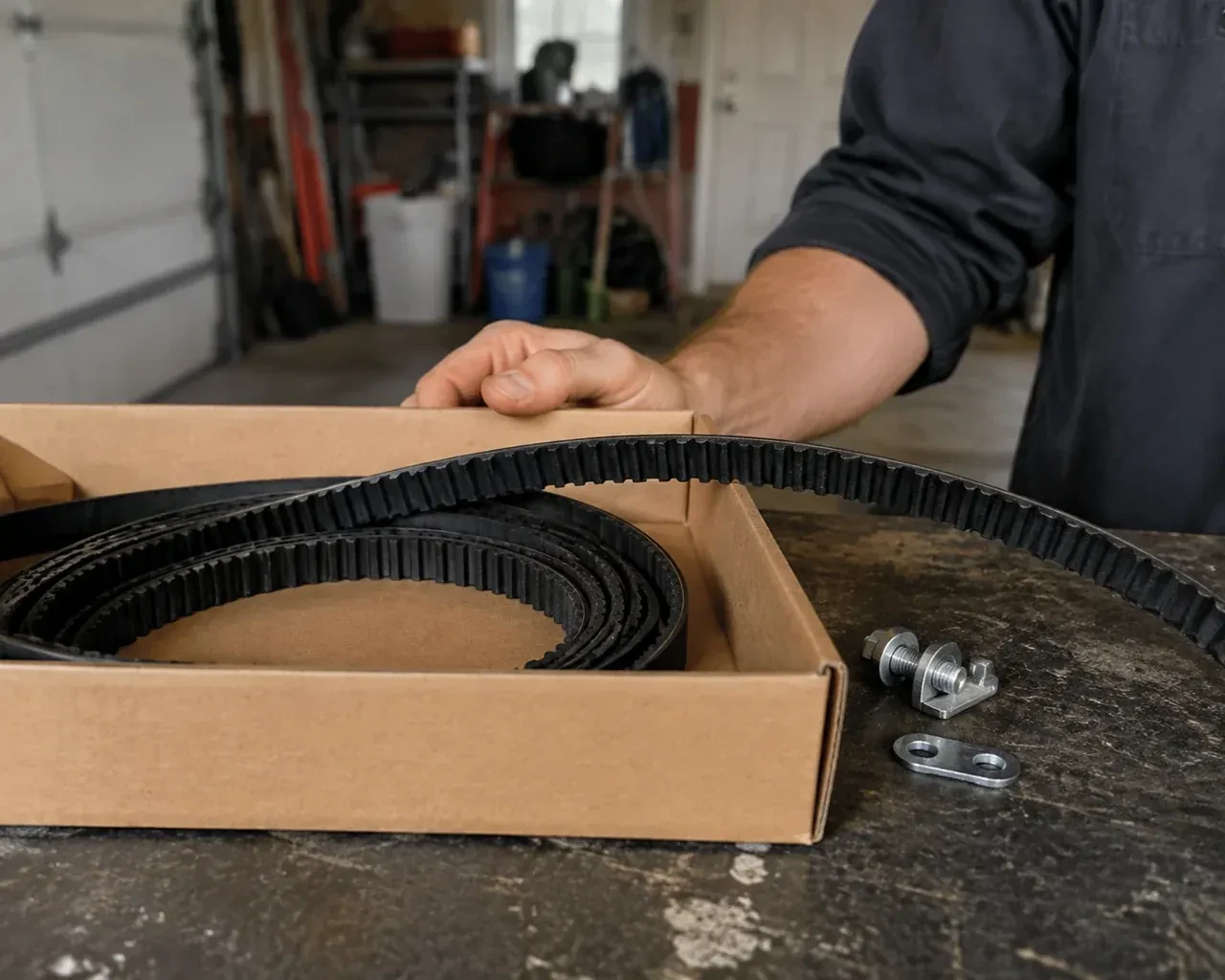
With the trolley run to one end of the rail and then the other, the whole length of the belt passes under the technician's eye and fingers, on the top run and the return. What they are looking for is specific: cracks across the back of the rubber, a glazed shine that says the belt has been slipping, an edge gone fuzzy from rubbing, a stretch where the teeth are flattened or torn away, cords showing through, and the state of the clip or link where the belt meets the trolley. Each of these points to a different cause as well as a different repair, and where the wear sits along the belt says a lot about which.
Putting motor and trolley back in step
Any time the belt has been off the sprocket, the operator's sense of where the door is can drift from where the trolley actually sits, so this step is done before the door is reconnected. The technician lifts the belt clear of the sprocket, runs the operator until the sprocket turns to its closed position and stops on its own, then slides the trolley to the closed end of the rail and refits the belt. Motor and trolley now agree. On operators with a mechanical limit assembly, the middle contact is adjusted instead. Without this step, the door stops short at one end no matter how the travel limits are turned.
A record of what was done
Before leaving, the technician writes down the operator's model and serial number, which belt or parts went in, the tension setting used and the date, and hangs the note with the manual near the wall control. You are shown what was replaced and why, and the old parts are yours to keep or are taken away. Keep the note; a belt has a service life measured in years and cycles, and knowing when this one went in tells the next technician where to look. Any settings the operator lost during the work, such as remotes or a keypad code, have been re-taught and tested with you.
Belt-Drive Opener Repair
In the van
- 2x4 offcut for the reversal test
- Light grease for the drive gear
- Rail joint brackets and stop bolts
- Inner and outer trolley
- Door arm and clevis pins
What affects the quote
Same fees day, night or weekend
1Door work found during the balance test
If the door is heavy in the hands when lifted with the operator released, the springs, cables or rollers behind that are priced as their own job, separate from the belt.
2Idler pulley
A squealing or wandering pulley at the header end of the rail is a separate part and a few extra minutes with the belt slack, quoted only when the inspection finds it.
3Adjustment or replacement
A tension adjustment with the safety tests is the smallest visit. A new belt, with a fresh clip, phasing and relearned limits, is a larger one, and the inspection decides which you need.
Belt-Drive Opener Repair: questions
What are the signs a belt is wearing out?
Cracks across the back of the rubber, a shiny glazed surface, a fuzzy or frayed edge, teeth worn flat or torn away in a stretch, and cords showing through the rubber. The clip at the trolley can also go brittle and snap. Most belts show one of these long before they fail, which is why a glance along the rail every few months catches a repair early.
How do I know the belt is the problem and not something else?
Look and listen. A belt that hangs below the rail, slaps on the way up or clicks at the same point each cycle is a belt fault. A motor that runs with the door still might be a broken belt clip, a stripped gear or a belt off the sprocket. A door that is heavy when you lift it by hand with the operator released is a spring matter. The technician confirms which before any part is ordered.
Is a belt drive harder to repair than a chain drive?
No, just different. The belt is lighter, runs dry and is replaced as one length with a clip, where a chain has links and takes grease. The tensioning at the trolley works the same way on both, and the sprocket, idler and trolley are similar parts. What a belt drive rewards is care with tension and a straight rail, because it is chosen for quiet and shows any fault as noise.
Openers & Access
- Chain-Drive Opener RepairThe door opens about a third of the way and stops.
- Garage Door Opener ReplacementThe bedroom above the garage shakes every morning at six when the chain drive fires up.
- Photo-Eye Sensor Alignment or ReplacementOn bright mornings the door will not close, then by lunchtime it behaves itself.
Belt-Drive Opener Repair near you
For properties in Waterloo we service the door, the hardware that lifts it and the opener that drives it, and we install new doors and openers when the old ones are done. Residential and commercial work are both covered, each with its own parts, tools and approach.