Repairs · St. Clements
Garage Door Perimeter Weatherstrip in St. Clements
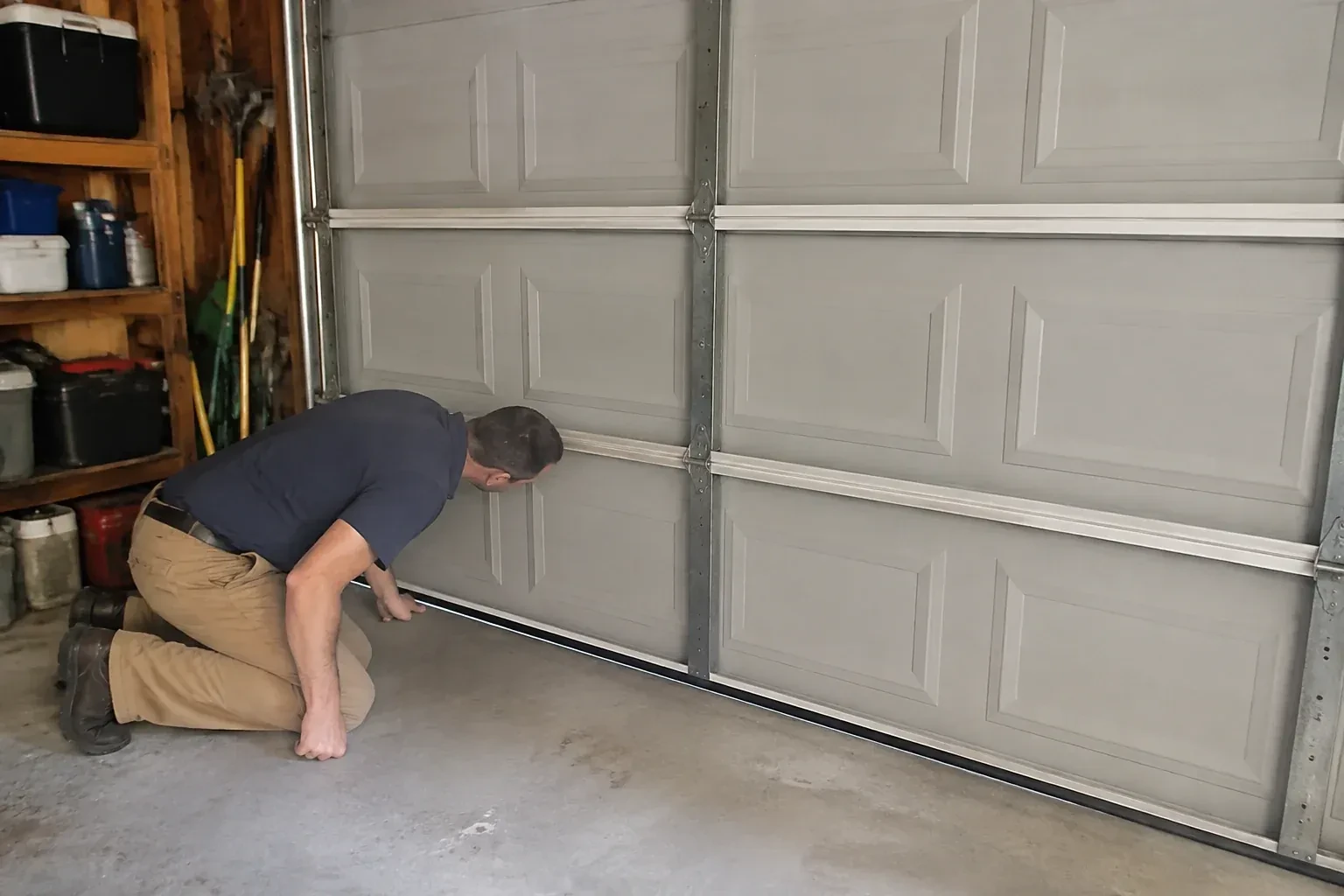
The bedroom over the garage is always the cold room, and standing in the garage you can feel why: a steady draft along the door edges that moves the cobwebs on the wall. The seal around the opening has flattened to nothing.
Garage Door Perimeter Weatherstrip
In plain words
Perimeter seal comes in two common forms, and the visit begins by deciding which suits your opening. The simpler is a flexible vinyl fin nailed to the face of the existing wood stop, which works well where the stop is sound. The other is a one-piece vinyl stop moulding with the fin built in, which replaces the wood stop altogether and suits jambs that are weathered or where the old stop is cracked and paint-heavy. Commercial doors sometimes carry an aluminum retainer with a replaceable rubber insert. Each is cut to your header and sides on site and set against the closed door.
How the visit goesThe vinyl strip around the door used to be soft and white. Now it is grey and hard, cracked every few inches, and a piece near the corner snaps off in your fingers. It no longer bends toward the door at all.
St. Clements
How the visit goes
Measuring for the new pieces
With the door closed, the header is measured across the full width of the opening and each side from header to floor, because openings are rarely the same on both sides. The profile is chosen to match the gap: a wider fin for a door that sits a little back from the stop, a narrower one where the gap is slight, and a one-piece stop where the wood is going. Colour is matched to the trim from a range of standard finishes. The technician also notes whether the existing stop projects far enough to cover the door edge, since a stop set too shallow leaves the fin working alone.
The header piece goes on first
With the door closed, the header length is cut to the full width of the opening and lifted into place, a two-person job on a double door. It is positioned so its fin lies against the top section with a slight, even deflection along the whole width, then fastened from the centre outward with galvanized or stainless nails or exterior screws at regular spacing, which keeps the length straight rather than letting it wander. The ends are left to receive the side pieces beneath them. Fitting the header first means both sides are cut to meet it exactly, and the corners close properly.
Corners that stay closed to pests
With the header and side fins overlapped, the small square holes that mice and wasps used are gone. Keep them that way by checking the four corners each autumn, when animals are looking for warmth, and pressing any lifted corner back into place. The point where the side seal meets the bottom seal on the door is worth a look too, since the bottom seal wears on its own schedule. A clear threshold, with leaves swept away from the door, removes the shelter pests use to work at a corner. Sealing the perimeter is one of the simpler parts of keeping a garage pest-free.
Garage Door Perimeter Weatherstrip
In the van
- Tape measure, level and square
- Utility knife and mitre saw
- Galvanized or stainless trim nails
- Flexible vinyl fin seal
- Exterior caulking and gun
What affects the quote
Same fees day, night or weekend
1Colour and profile
Standard colours and fin widths are carried on the truck. A less common colour, an extra-wide fin or a commercial retainer with insert may be a special order, with the difference noted.
2Fin on the existing stop or a one-piece vinyl stop
Nailing a new fin to a sound wood stop uses less material than replacing the stop with a one-piece vinyl moulding, which costs more as a part but needs no paint and does not rot.
3Corner detailing
Mitred corners on a one-piece stop, or fitting round an unusual trim profile, take more cutting and fitting than butted corners on a plain jamb.
Garage Door Perimeter Weatherstrip: questions
How long does the visit take?
A straightforward fin replacement on a single door is often a matter of an hour or two once the technician is set up; a double door with a one-piece stop takes longer, and any jamb repair adds to it. Most of the time goes into checking the door, preparing the surface and setting the contact carefully, since those are what make the seal last. You are given a sense of the timing when the work is confirmed.
Does new weatherstrip make the door any quieter when it opens and closes?
A little, though it is not the main reason to do it. A fresh bottom seal cushions the door's contact with the floor, and snug side and top seals stop the panel rattling against loose or worn stops. Most of the noise people notice from a garage door comes from rollers, hinges and the opener chain or belt rather than the seals, so a technician checking the weatherstrip will usually point out those parts too if they are the louder culprit.
How is the seal fastened to the frame?
A flexible fin is nailed or stapled to the face of the wood stop with galvanized or stainless fasteners spaced evenly along its length; a one-piece vinyl stop is nailed or screwed through its rigid edge into the jamb and header. Fasteners go into sound wood, heads are set flush without crushing the vinyl, and the joint between stop and trim is caulked where water could get behind.
Repair & Maintenance
- Garage Door Tune-UpThe door lands with a thud you can feel through the kitchen floor, and sometimes it bounces back up…
- Off-Track Garage Door ResetThe morning after a thaw the opener groaned, the door stayed stuck to the icy floor for a second…
- Garage Door Panel ReplacementFrom outside, the horizontal groove between two sections now steps sideways by a centimetre.
Garage Door Perimeter Weatherstrip near you
We think of garage door work in St. Clements as keeping a heavy moving object safe and smooth. That covers spring and cable work, tracks and rollers, opener force and sensor settings, seals against the weather, and complete door replacement when a repair no longer makes sense.