Openers · St. Clements
Garage Door Opener Replacement in St. Clements
The bedroom above the garage shakes every morning at six when the chain drive fires up. Everyone in the house knows the moment someone leaves for work.
Garage Door Opener Replacement
In plain words
Openers have changed more than most people realise. Many units from before the early 1990s relied on motor resistance alone, without a photo-eye pair near the floor, though some carried a sensing edge or a close control instead. Fixed-code remotes set by tiny switches were common then too, so the same setting could open more than one door. A modern operator adds a beam across the opening, a force limit that reverses on contact, a rolling code that changes with every press, and a lock button that switches remotes off at night. Replacement brings all of those at once, and the safety tests are run in front of you.
How the visit goesThe bedroom above the garage shakes every morning at six when the chain drive fires up. Everyone in the house knows the moment someone leaves for work. The door itself is fine; the racket comes from the operator and its steel chain.
St. Clements
How the visit goes
Reading the old opener
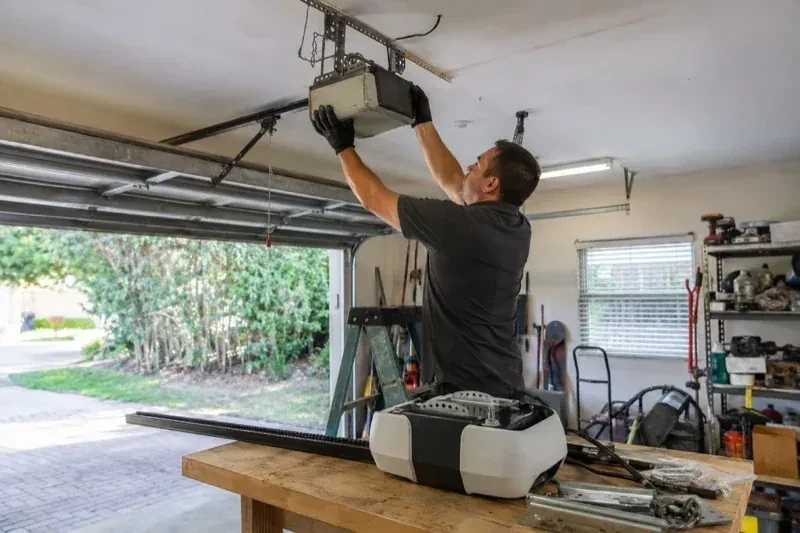
The existing unit has a story to tell. Its label gives the make, model and year, which says whether it predates photo-eye sensors and rolling-code remotes. The technician checks for oil leaking from the gearbox, plastic shavings from a stripped gear, scorching on the board, a bent rail or a worn trolley, and whether the travel limits have been fighting the door. This confirms the replacement is the right path and shows what, if anything, can be kept: the low-voltage wiring to the wall console is often reusable, while sensors and controls are matched to the new brand and generally come with the unit.
Building and hanging the new rail
The rail sections are joined on the floor, the trolley is threaded on and the chain or belt is fitted and tensioned to the maker's setting before the assembly is bolted to the head. The header bracket is fastened with lag screws into solid framing centred above the door, high enough to clear the top section at the highest point of its travel. The head is then raised, hung from the ceiling joists with perforated angle iron cut to length, and adjusted until the rail runs level and in line with the door's centre. A rail that is true to the door keeps the trolley from binding and keeps the drive quiet for its whole life.
Keeping the door balanced under the new operator
The new operator will run for many years if the door it moves stays balanced. Once a season, pull the release with the door closed, lift it by hand to about a metre and let go: it should stay there. If it drops or creeps upward, the springs have drifted and want a tune before the operator starts working harder to compensate. Watch too for a door that pauses or jerks at one point in its travel, which is usually a roller or a track bracket rather than the motor. A yearly service visit that checks balance, cables, rollers and the safety tests keeps both the door and the operator in step with each other.
Garage Door Opener Replacement
In the van
- Top-section reinforcement strut
- Perforated angle iron hangers
- Low-voltage bell wire and staples
- Opener head unit
- Photo-eye sensors
What affects the quote
Same fees day, night or weekend
1Power at the head unit
If a grounded receptacle is already close to the operator, nothing is added. If one must be installed or moved, that electrical work is quoted separately by an electrical contractor.
2Drive type
A chain drive, a belt drive, a direct-drive unit and a wall-mount operator sit at different points on the equipment list, and the choice is shaped by noise, ceiling space and door weight.
3Door height and rail length
A standard rail suits a 7 ft door. An 8 ft door or a taller custom door needs a rail extension, and a very low ceiling may call for a low-headroom arrangement, each an item on its own.
Garage Door Opener Replacement: questions
What happens to the old opener?
The technician takes it away. The steel rail, chain and angle iron go to metal recycling and the head unit, with its motor and circuit board, goes to electronics recycling rather than the landfill. Old remotes are cleared from memory before they are discarded or handed back to you, and any wiring that is not being reused is removed from the ceiling and walls so the garage is left tidy.
What is the red cord for?
It is the manual release. A tug on the red handle unhooks the trolley from the door arm so the door can be raised and lowered by hand while the power is off or the operator is being serviced. It hangs high enough to clear a vehicle roof but low enough to reach without a ladder. To reconnect, most units need only be run once and the trolley picks the arm back up; a few take a second tug.
What is a wall-mount opener and who is it for?
It is the operator that lives on the wall rather than the ceiling. Fixed where the torsion shaft ends, it rotates the shaft to raise and lower the door, and nothing hangs overhead. It suits cathedral and low ceilings, garages with lofts or lifts, and anyone who wants a very quiet door. Because there is no trolley holding the door shut, it comes with a powered deadbolt on the track and a monitor that stops the door if a lift cable slackens.
Openers & Access
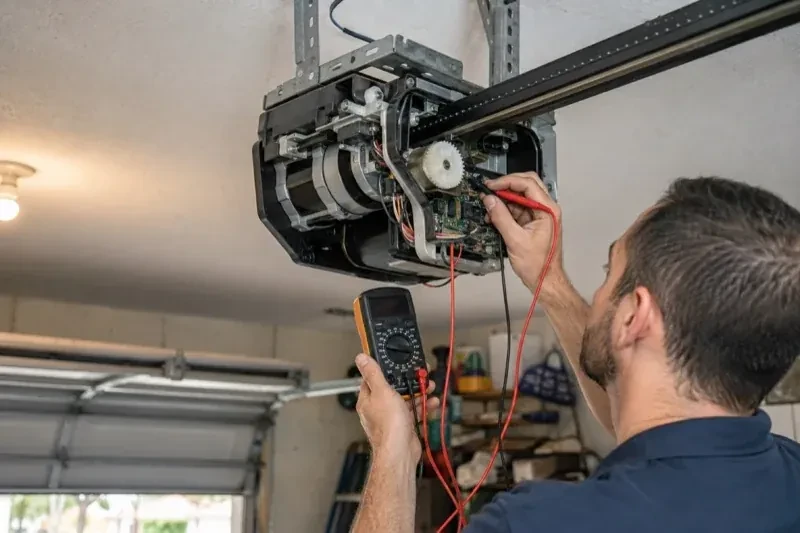
- Chain-Drive Opener RepairThe door opens about a third of the way and stops.
- Belt-Drive Opener RepairThere is a new squeal from the front of the rail, up near the header, on every cycle.
- Photo-Eye Sensor Alignment or ReplacementOn bright mornings the door will not close, then by lunchtime it behaves itself.
Garage Door Opener Replacement near you
We think of garage door work in St. Clements as keeping a heavy moving object safe and smooth. That covers spring and cable work, tracks and rollers, opener force and sensor settings, seals against the weather, and complete door replacement when a repair no longer makes sense.